 c2cd615824
The site had drifted from the product. Every screenshot predated the
v0.5.0 UI redesign, the reading experience shipped no search and no
syntax highlighting, and a third of the pages were internal process
artefacts — migration task lists addressed to agentic workers, a
release runbook, a proposal marked "historical".

Reorganise around the only two people who read this: someone getting
the desktop app running for the first time, and someone reading the
source. Five sections replace nine — start / desktop / im / cli /
internals — and the pages that served neither reader are gone.

Site rewrite:

- Palette lifted from the desktop app's 「纸·墨·印」 themes, so the
  site and the product read as one thing. Light mirrors 纯白, dark
  mirrors 墨夜, and dark mode exists at all now.
- Fonts are self-hosted. The old @import from Google Fonts is
  unreachable from mainland China, which left every heading in a
  fallback serif; it also only requested weight 600 while the CSS
  asked for 900, so Latin and CJK in the same heading disagreed.
- Docs were shipped as one 968KB manifest downloaded on every page
  view. Split into a 32KB index plus one lazily imported chunk per
  page; the entry bundle is now 101KB gzipped.
- Add search, syntax highlighting, per-route meta with canonical and
  hreflang, a sitemap, and an error boundary. Replace the 44vh
  mobile sidebar with a drawer.
- Image dimensions are read at build time and written into the tag,
  so lazy images reserve their space instead of collapsing.

Screenshots are recaptured from a real v0.5.0 build against a clean
demo project, with tokens, QR codes and paired accounts redacted.
The previous set is deleted rather than kept alongside.

Routes follow file paths, so the restructure would have broken every
inbound link; 37 old paths redirect, in both languages. The PR policy
gate and CODEOWNERS also hardcoded docs/guide/contributing.md.

Verified: check:docs 78 pages / 323 links / 0 problems, check:policy
127 pass. Walked every route at 1440 and 390 in both themes for
overflow, contrast, keyboard reachability and focus management.
4.9 KiB
| title | nav_title | description | order |
|---|---|---|---|
| Computer Use | Computer Use | Let Claude read your screen, move the mouse, and type into other apps. | 7 |
Computer Use
With Computer Use enabled, Claude can take screenshots of your screen, move the mouse, click, and type — driving applications that have no API at all: system settings, native note apps, Finder, third-party desktop software.
It acts on this computer, so read what you're authorizing before you turn it on.
macOS and Windows are supported. There is no Linux executor yet.
Preparing the environment
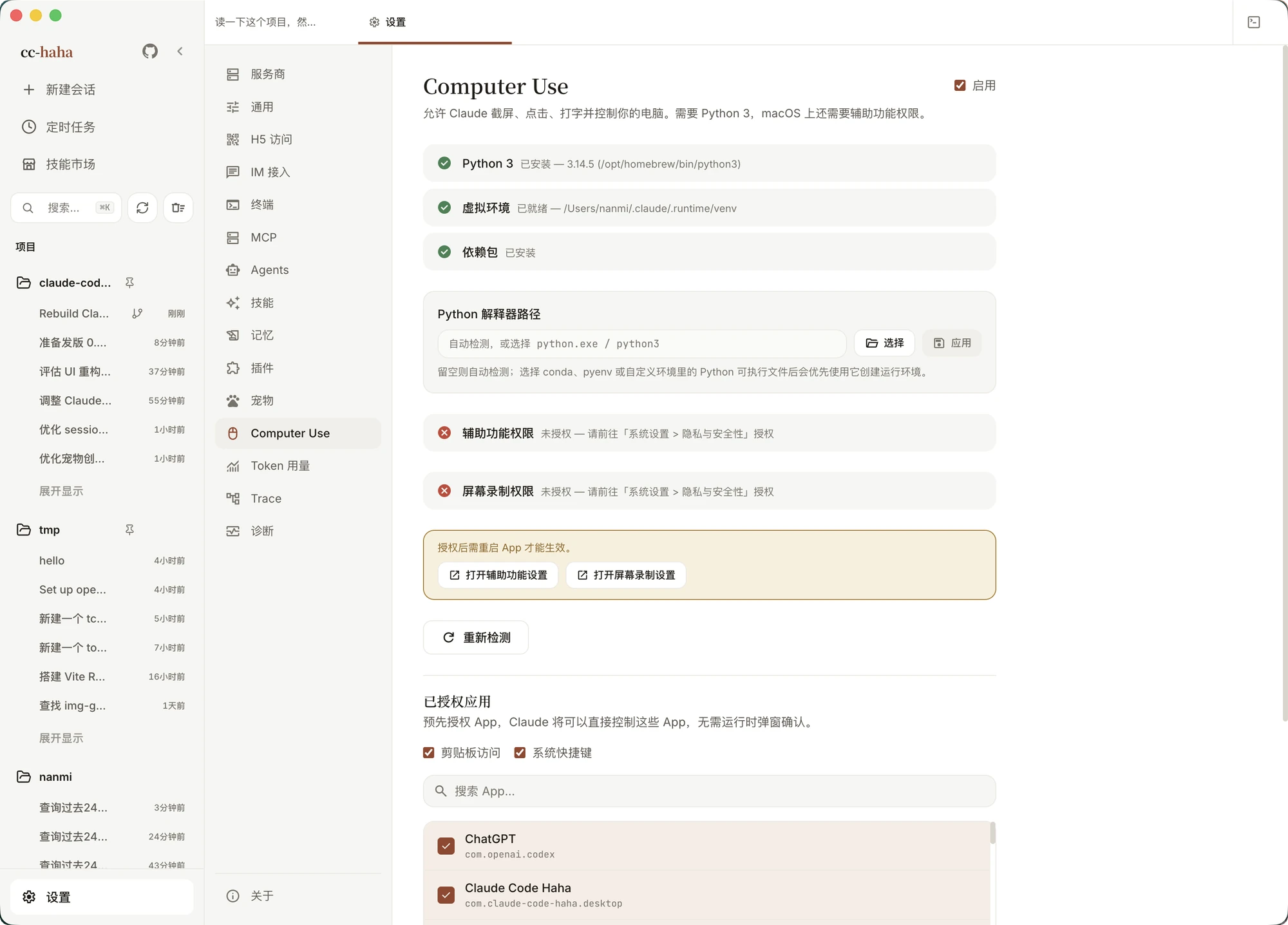
Open Settings → Computer Use. The top of the page is a row of environment checks:
- Python 3 — required on your machine. If it isn't found, click Download Python 3. If your Python lives in conda, pyenv, or another custom environment, pick the executable under Python interpreter path and it will be preferred from then on.
- Virtual environment and Dependencies — click Install Environment and the app creates an isolated venv and installs the platform dependencies. Your global Python is left alone.
- When everything is green the page says all checks passed and Computer Use is ready.
Re-check re-runs the detection at any time.
The two macOS permissions
macOS additionally requires two system permissions. Neither is optional:
| Permission | What it's for |
|---|---|
| Accessibility | Moving the mouse, clicking, typing |
| Screen Recording | Taking screenshots — i.e. letting it see |
The page has Open accessibility settings and Open screen recording settings buttons that jump straight to the right pane.
:::warning After granting either one you must fully quit and reopen the app. macOS reads these permissions once at process start, so without a restart the page will keep reporting them as not granted. :::
Make sure you're granting the permission to the app that actually launches Claude Code Haha. Screen Recording detection is occasionally unreliable — if the system settings clearly show it granted but the page still says otherwise, it generally works anyway.
Pre-authorized apps
By default, every time Claude wants to control a new app it raises a "Computer Use wants to control these apps" prompt naming the apps and the reason. You can Allow for session or Deny.
For apps you keep approving, tick them under Authorized Apps in settings and Claude will control them without prompting. The search box filters your installed apps.
Two more grants are separate and never come along with an app authorization:
- Clipboard access — reading and writing the system clipboard.
- System key combos — sending system-level shortcuts.
:::danger Pre-authorization is permanent approval. Keep password managers, banking apps, and corporate chat off that list — make it ask, every time. :::
Getting started
Start a session and describe the goal and the allowed apps in plain language. Begin with something small and reversible:
Take a screenshot and tell me what you see.
Open Notes and create an empty note titled "test".
Find the Displays pane in System Settings, but don't change anything.
Claude works in a screenshot → decide → act → screenshot loop, so it's slower than you are and will occasionally misclick. Explicit boundaries ("only inside app X", "don't save") work far better than a broad goal.
Only one session can drive the mouse and keyboard at a time. If you see that another session holds it, stop or finish that session first.
Known limits
- There is no global abort hotkey. Use the stop button in the session (
⌘.). - Windows screenshots aren't filtered. On macOS a screenshot keeps only authorized apps and the desktop; on Windows every visible window is captured. Close or minimize anything sensitive first.
- Browsers and terminals are restricted. Browsers are read-only (visible but not clickable) and terminals and IDEs are click-only (no typing). Use the browser extension for web pages and the Bash tool for commands.
- Re-screenshot after the UI changes. Old coordinates don't survive a page change.
Troubleshooting
The page keeps saying permissions are missing Confirm you granted them to the app that actually launches Claude Code Haha, fully quit and reopen, then click Re-check.
The environment won't install
Pick an explicit Python 3 under Python interpreter path, confirm it supports venv, and click Install Environment again. If it still fails, check the install log in Settings → Diagnostics.
Screenshots work but clicks don't Make sure the target app is in the authorized list and is currently in the foreground. Browsers and terminals are subject to the tier restrictions above.
For the permission tiers, the Python bridge, and the executors, see Computer Use architecture.